 Skull Fire
The Legend That United the Tribes
The Salmon Squatch
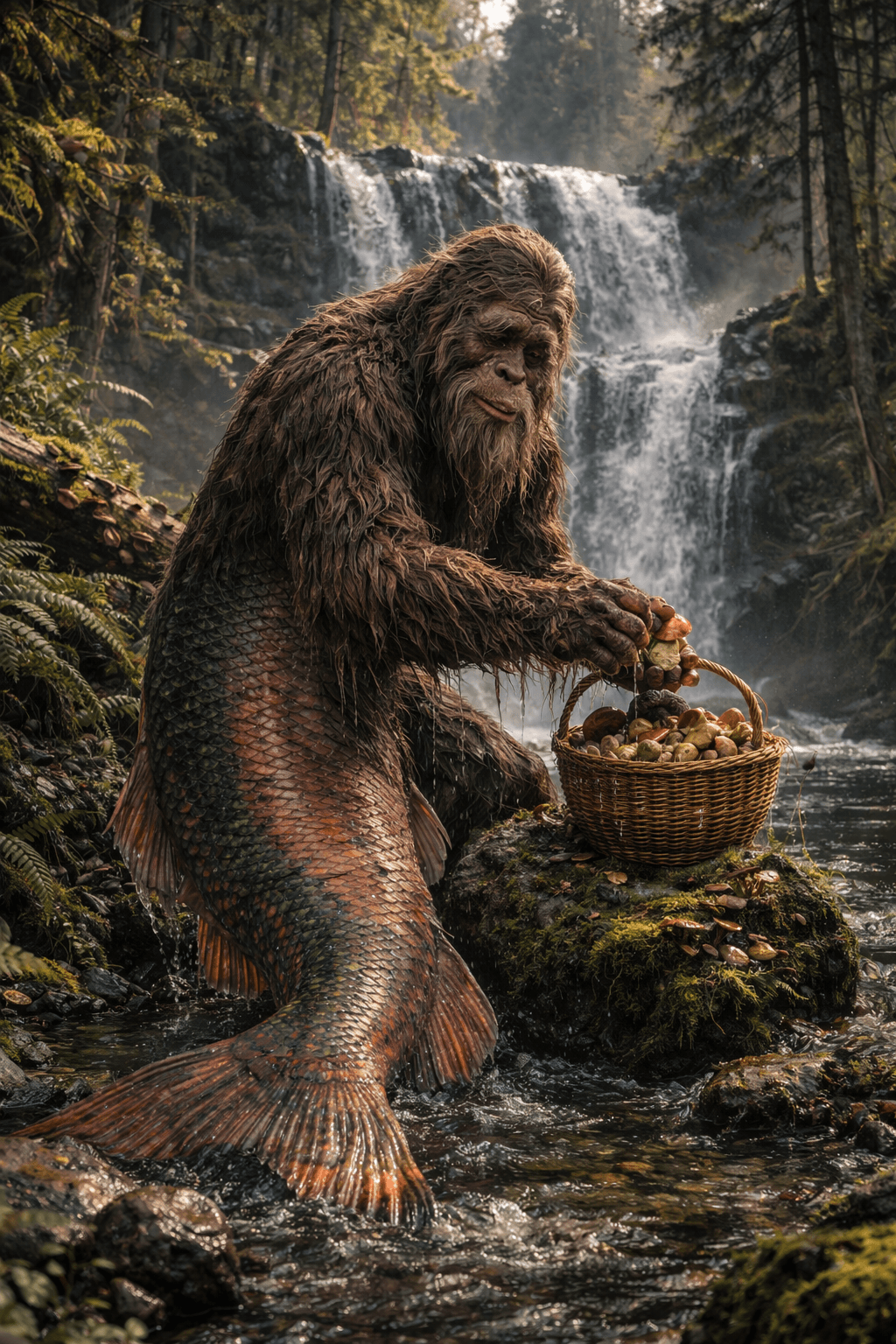
Nobody knows how long he's been out there. The rippies say he was here before the trails, before the timber roads, before anyone thought to name the ridges. He was just part of the forest — like the fog, like the cedar, like the rivers that carved the valleys before men ever walked them.
The first sighting belonged to a rippie. Deep in the woods, miles past the last marked trail, somewhere above the fog line where the ferns grow chest-high and the light barely reaches the ground. He was out foraging — eyes down, looking for chanterelles in the moss — when he saw the prints. Not boot prints. Not bear prints. Fin prints. Pressed deep into the mud like something massive had walked through on legs that shouldn't exist.
He followed them to a clearing near the river. And there it was.
Ten feet tall. Standing in the shallows where the current runs fast and the coho stack up in the fall. Part sasquatch, part salmon — scaled where it should have been furred, finned where it should have been footed, eyes like amber fire but not angry. Not threatened. Just there. Living its life in a place where nobody was supposed to be watching.
The rippie stood frozen. Heart in his throat. He smelled pine and salmon and rain-soaked earth all at once. He thought about calling it in. Grabbing the radio. Telling somebody. But he looked at those amber eyes and he didn't have the heart. Who was he to pull something that wild out of the green? Who was he to say what should and shouldn't be seen?
He went home. Didn't tell his queen. Didn't tell his neighbors. But he couldn't hold it forever.
He told it at the fire.
The next time the rippies came down from the hills to meet the seabillies at the waterline, he waited until the coals were low and the whiskey was talking, and he told the story. Fin prints in the mud. A creature that made no sense. Something standing in the river that God either made as a joke or a miracle, and he still couldn't tell which.
The seabillies laughed at first — harbor folk always do. But the rippie didn't flinch. He described the eyes. The smell. The way it moved through the water like it belonged there more than any of them ever would. The way it looked at him and chose not to run, like it was deciding whether he was worth trusting.
The laughter stopped.
A seabillie — one of the old ones who'd been on the water forty years — said he'd seen something once, out past the channel markers on a night run. A shape in the water too big to be a seal, too upright to be a fish. He never told anyone either.
Then a chippie spoke up. Quiet, the way chippies do when they've been thinking for a while. He said he'd been running data on wildlife migration patterns for a forestry project, and there was a gap — a zone in the hills where no GPS collar had ever returned a signal. Not broken. Not dead. Just gone. Like the forest swallowed the data and decided to keep it.
Three tribes. Three witnesses. Three different kinds of evidence — eyes, instinct, and data — all pointing at the same impossible thing.
They didn't organize a search party. They didn't call the news. They didn't try to prove it. That's not what Skull Fire does with a mystery. Instead, they made a pact around that fire: the Salmon Squatch belongs to the wild. You can't put him on your catch card. You can't pin him to a wall and call yourself a man. You can't drag him into the light when he was made to stay hidden in the night.
If you ever see him yourself, you do the same thing that rippie did. You let him go. He's not to blame for being something that doesn't make sense. He's just one of God's creations that defies explanation — half fish, half beast, all mystery — high on mushrooms in the fog, living his life in a world that wasn't built for him but keeps him anyway.
The Salmon Squatch became the thing the three tribes share that nobody else will ever understand. The rippies saw him first. The seabillies felt him on the water. The chippies found his ghost in the data. And all three agreed: some legends don't belong to any man to claim.
Let him run. Let the river keep his name.